GPTZero et Turnitin peuvent ne pas être d’accord
GPTZero peut signaler le rythme des phrases, alors que Turnitin évalue l’ensemble du document. Réécrivez les passages qui paraissent trop réguliers, puis vérifiez le brouillon que vous allez remettre.
Le Détecteur d’IA de TurnitPass met en évidence les passages à corriger. L’Humaniseur d’IA peut viser GPTZero ou Turnitin afin que la réécriture corresponde à la vérification à laquelle vous êtes réellement confronté.
Comment GPTZero et Turnitin estiment le score IA
Pour bien écrire lorsque les brouillons sont systématiquement analysés, il est utile de comprendre ce que des outils comme GPTZero et Turnitin mesurent réellement. Ils vérifient si votre prose est anormalement uniforme ou prévisible par rapport à l’écriture humaine habituelle.
Lorsque chaque phrase a une forme semblable et que chaque paragraphe se termine de la même façon, GPTZero et Turnitin signalent souvent ces passages comme trop réguliers.
Introduisez une véritable variété : des phrases courtes après des phrases longues, des exemples précis et des transitions qui expliquent votre raisonnement. Cela réduit les signaux typiques de l’IA et rend l’écriture plus claire.
Indicateurs de style et facteurs de risque de faux positifs
Les faux positifs restent l’un des aspects les plus difficiles de la détection. Comme ces systèmes reposent sur la reconnaissance de schémas, un texte très structuré ou formel peut être signalé alors qu’une personne a écrit chaque mot. Les essais académiques et la documentation technique en sont les exemples habituels.
Lorsque vous écrivez dans un style qui minimise la voix personnelle ou le rythme varié, des détecteurs comme GPTZero et Turnitin font souvent monter le score. Les phrases qui commencent par des connecteurs comme « en outre », « de plus » ou « il est important de noter que » paraissent prévisibles.
La réponse pratique consiste en une variété authentique : des réflexions personnelles, des exemples directs et une longueur de phrases mixte. Vous pouvez respecter des exigences académiques ou professionnelles sans écrire selon un modèle rigide.
Les termes techniques spécialisés ou les affirmations mathématiques peuvent aussi sembler prévisibles. Laissez ces termes intacts et variez l’explication qui les entoure, afin que le brouillon se lise toujours comme votre travail.
Techniques de révision pratiques pour les brouillons à risque
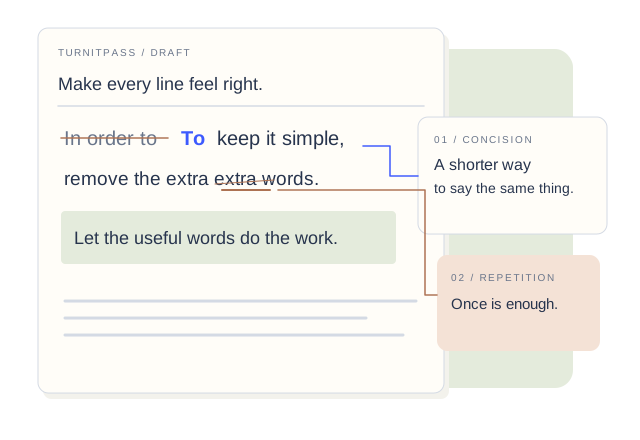
Remplacer des mots au hasard ne fonctionne guère lorsque les structures de phrases restent uniformes. Commencez par réécrire les transitions et varier la longueur des phrases.
Procédez par couches : remplacez les connecteurs génériques par des transitions adaptées au contexte, puis découpez les longs blocs à propositions multiples. Expliquez le lien entre les idées au lieu d’empiler la même formule de liaison.
Les exemples et les données précis distinguent aussi un texte. Un outil générique ne peut pas inventer vos notes de terrain, les détails de votre consigne ou les faits de votre client.
Gardez inchangés les références factuelles, les citations et les extraits cités.
- Variez le rythme en alternant des énoncés courts et des phrases explicatives plus longues.
- Supprimez les mots de transition génériques et répétitifs, et expliquez comment vos idées se relient.
- Gardez inchangés les affirmations factuelles, les chiffres, les noms, les dates et les citations bibliographiques.
Du score du détecteur à un brouillon plus propre
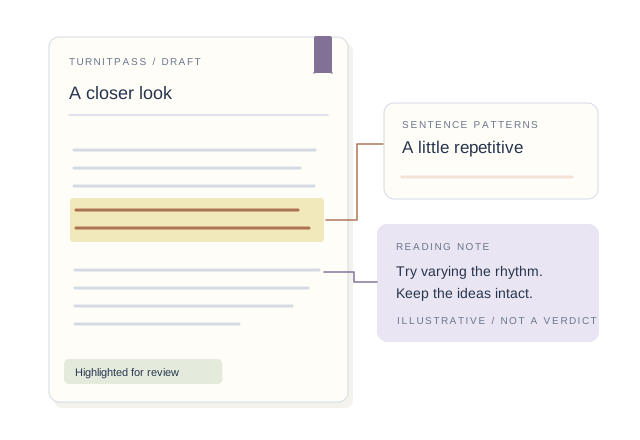
Le Détecteur d’IA de TurnitPass analyse le texte collé ou importé et renvoie un signal global, des remarques sur les schémas et des passages en surbrillance.
Poursuivez avec l’Humaniseur d’IA pour réécrire les lignes signalées, puis comparez le résultat côte à côte avec l’original. L’Humaniseur d’IA peut viser GPTZero ou Turnitin après l’analyse.
Analysez la version modifiée, puis copiez ou téléchargez le résultat.
Bonnes pratiques pour garder une prose professionnelle
Lorsque vous révisez pour réduire les signaux typiques de l’IA, gardez une prose claire.
Pensez au lecteur : des arguments logiques, des preuves présentées et des transitions naturelles. C’est ce type de communication que les gens veulent vraiment lire.
Analysez d’abord, humanisez les passages signalés, puis vérifiez le brouillon révisé. La détection et la réécriture se trouvent dans le même produit : vous pouvez passer d’une ligne à risque élevé à une version plus propre sans changer de site.