TurnitPass
GiáAPIBlog
Đăng nhậpKhu vực làm việcBắt đầu miễn phí
BlogStudents

Using ChatGPT for Essays Without Losing Your Own Argument

Use ChatGPT for planning and critique, then revise the final draft around your sources, thesis, and voice.

30 thg 4, 20267 phút đọc
aà中

Academic Integrity in the Age of AI Assistance

Integrating artificial intelligence into the academic workflow presents both opportunities and significant ethical responsibilities. While tools can expedite the initial phases of research, such as structuring outlines and consolidating raw notes, the core intellectual contribution must remain uniquely yours. Copying and pasting raw AI output directly into an academic draft runs counter to standard institutional policies and risks undermining your educational growth. By treating AI as a collaborative partner rather than a replacement for critical thinking, you ensure that your submissions reflect genuine learning. When analyzing essay drafting with AI, the focus should be on building a genuine outline first to anchor your research.

Many universities now run AI checks before grading. These tools do not replace a plagiarism review; they estimate whether a draft looks unusually uniform or AI-like. To protect your work against false flags, keep your drafting process transparent—start from a solid outline and add your own analysis under the guidance of Citation Generator.

Ultimately, maintaining integrity is about demonstrating your personal intellectual journey. A paper should not merely be a string of generic statements written only to satisfy a scan, but a cohesive argument that shows you have engaged with the coursework. Using editing workspaces like TurnitPass to polish your prose ensures that your research shines through without looking like a copy-paste job.

Preserving Individual Voice and Author Identity

Instructors who read student essays regularly can easily identify prose that lacks a personal voice. AI-generated drafts often feature highly uniform sentence lengths, clinical vocabulary, and a total absence of individual style or rhetorical variation. When your essay relies on generic summaries rather than concrete arguments, it loses its academic punch. Your unique perspective, shaped by class readings, personal experiences, and unique research findings, is what makes the paper valuable.

To make your essay stand out, inject specific class discussions, personal thesis statements, and unique evidence that a generic prompt cannot generate. Replace broad, sweeping statements with narrow, focused claims. For instance, instead of claiming that technology has transformed society, describe how a specific regulatory policy impacted a particular community. Using TurnitPass AI Humanizer helps clean up sentence flow while leaving your claims, citations, and specific arguments visible, ensuring your individual voice is never flattened.

A strong personal voice is also characterized by syntactic flow. Human writers naturally mix short, punchy observations with longer, explanatory statements. AI models, by contrast, write with uniform rhythm. Varying your sentence length and paragraph structure manually is the most reliable way to establish a natural cadence that readers appreciate.

Additionally, the use of active voice and varied transitions helps define your author identity. Passive structures and repetitive transitions often read as AI-like. Rewriting these sentences manually not only helps lower AI score but significantly improves the readability and impact of your arguments.

An Academic Checklist for Verifying Sources

One of the most significant risks of relying on raw generative outputs is the phenomenon of citation hallucination. Large language models are designed to predict the next plausible word in a sequence, not to verify bibliographic databases. As a result, they frequently manufacture convincing but entirely fictional journal titles, page numbers, and author names. Submitting a paper with fabricated sources is a severe academic violation, even if done unintentionally.

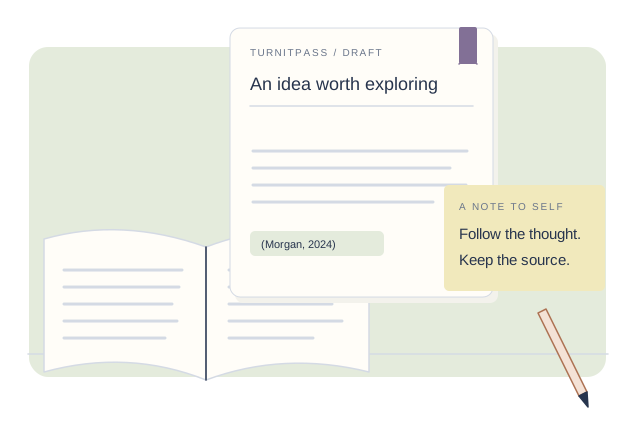
Therefore, a rigorous verification pass is a non-negotiable step in the academic writing process. Writers must check each reference against real databases (such as Google Scholar or PubMed), confirm that the cited source actually supports the claim made in the text, and format the bibliography properly. Using the Citation Generator, you can output clean, verifiable references in standard academic styles.

Furthermore, a proper citation check ensures that credit is accurately attributed to original researchers. Hallucinated sources undermine the entire foundation of academic inquiry. Taking the time to locate and verify each reference builds a stronger, more credible paper that stands up to peer and instructor review.

Using automated citation managers can streamline this process, but manual review is still essential to catch anomalies. TurnitPass integrates reference formatting directly into the workspace, allowing you to build compliance profiles in MLA, APA, or Chicago style while revising your text.

  • 1Double-check all direct quotes and paraphrase summaries against the original source documents.
  • 2Generate clean, compliant citations in APA, MLA, Chicago, IEEE, or Harvard formats using the Citation Generator.
  • 3Verify that the cited evidence directly supports the academic claim made in the surrounding paragraph.

Building a Solid Paper Trail of Outlines and Notes

Maintain a transparent writing process. Keep your outlines and draft history, and use editing tools specifically as a refinement layer rather than a text generator. This disciplined approach ensures that your final draft, polished under essay drafting with AI, remains entirely your own and stands up to any institutional review.

Having a record of your research process—including initial brainstorms, annotated bibliographies, and draft histories—provides undeniable proof of your authorship. It shows that the work evolved naturally through your own effort rather than appearing instantaneously from a generator.

Ultimately, a structured paper trail acts as your security blanket. By keeping clean records and using TurnitPass as your final editing environment, you can confidently discuss your paper with your instructor and prove your dedication to academic honesty.

In addition, document history files are highly persuasive evidence during grade appeals. Teachers appreciate seeing the revision steps, outline changes, and source notes, as it demonstrates academic effort and engagement with the assignment.

Refining the Final Draft for Submission

The final phase of the writing process should focus on style refinement and readability. Once your arguments are solid and your sources are verified, take a pass specifically dedicated to sentence variety and flow. Check that your transitions are logical and that your voice remains consistent throughout the document.

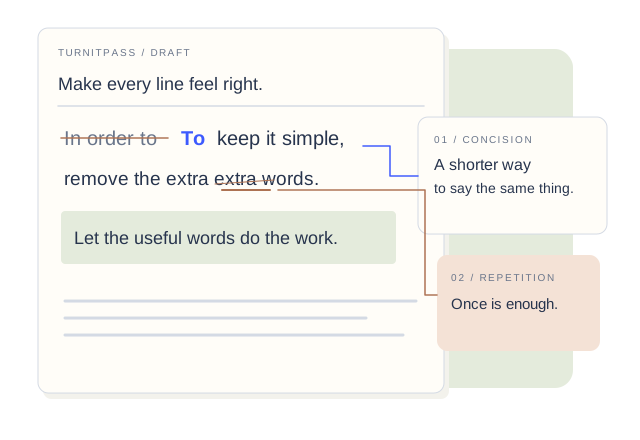
Avoid the temptation to use overly complex vocabulary or jargon simply to sound academic. The best scholarship is written in clear, precise, and accessible language. Refine your drafts to eliminate wordiness and ensure that each sentence has a clear purpose.

Using the TurnitPass editing tools, you can review your text for repetitive transitions and uniform cadences. This helps you identify sentences that might trigger flags and revise them to match human writing patterns without losing your research claims.

Finally, run a traditional proofreading pass for spelling, grammar, and punctuation. A clean, error-free document indicates academic care and respect for your reader. By following this systematic workflow, you can submit a polished paper that meets all standards of academic excellence.

ChatGPTessaysrevision

Sử dụng hướng dẫn

Biến bài viết thành một quy trình làm việc.

Nội dung blog không nên dừng lại ở những lời khuyên. Hãy sử dụng công cụ TurnitPass phù hợp, kiểm tra kết quả và liên kết bản chỉnh sửa cuối cùng với bản nháp gốc.

Kiểm tra bài luận

Xem lại các bản nháp học thuật để tìm tín hiệu AI trước khi nộp bài.

Mở

Trích dẫn nguồn

Tạo trích dẫn theo kiểu APA, MLA, Chicago, IEEE, Harvard, GB/T và các kiểu khác.

Mở

Nhân hóa bản nháp

Sửa đổi phần văn xuôi có sự hỗ trợ của AI trong khi vẫn hiển thị rõ lập luận, trích dẫn và giọng văn.

Mở

Đọc tiếp

Tất cả bài viết
Students

AI Writing Tips for Students Who Still Need Their Own Voice

How to use AI for outlining and revision without submitting a draft that sounds disconnected from the student.

Students

Academic Integrity and AI Writing: A Practical Revision Guide

How students can use AI-assisted drafting responsibly while keeping evidence, authorship, and revision history clear.

Students

Best ChatGPT Prompts for Essays and How to Revise the Output

Prompt ideas can help with structure, but the final essay still needs source checks, voice, and careful rewriting.

Get started

Làm bản nháp AI tự nhiên hơn, kiểm tra dấu hiệu AI và giữ quy trình viết trong một khu vực làm việc rõ ràng.

Bắt đầu miễn phíAPI
TurnitPass

Làm bản nháp AI tự nhiên hơn, kiểm tra dấu hiệu AI và giữ quy trình viết trong một khu vực làm việc rõ ràng.

Sản phẩm
  • Nhân hóa văn bản AI
  • Công cụ phát hiện AI
  • Kiểm tra bài luận
  • Phát hiện AI cho giáo viên
  • API
  • Nhà phát triển
  • Khu vực làm việc
Tài nguyên
  • Giá
  • Blog
  • So sánh
  • Cập nhật sản phẩm
  • Giới thiệu
  • Liên hệ
Pháp lý
  • Quyền riêng tư
  • Điều khoản

© 2026 TurnitPass. All rights reserved.

All systems normal