TurnitPass
GiáAPIBlog
Đăng nhậpKhu vực làm việcBắt đầu miễn phí
BlogDetection

Winston AI Alternatives for Detection Plus Revision

Compare AI Detector-only products with workflows that help rewrite high-risk passages after the scan.

28 thg 3, 20267 phút đọc
86

How Winston AI Estimate AI Score

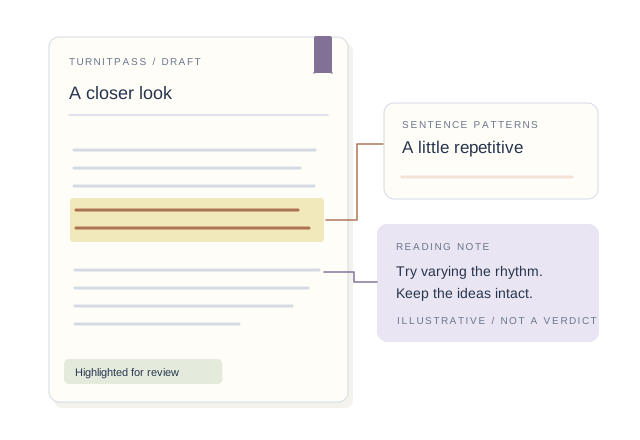
Feedback from Winston AI can feel arbitrary, but these tools often flag repetitive structure, predictable transitions, and even sentence length. Human writers naturally mix short remarks with longer, detailed clauses, which is why revision should focus on rhythm and specificity—not on chasing a single score. The study of Winston AI alternative evaluation shows that overly predictable flow is a common trigger.

When every sentence has a similar shape and every paragraph closes the same way, the draft can read as machine-written even if you wrote it yourself. That is why Winston AI highlights passages that feel too regular.

The goal of revision is not to write poorly, but to add real variety: shorter lines after long ones, specific examples, and transitions that explain your logic. That approach usually lowers AI score while making the writing clearer.

Style Indicators and False-Positive Risk Factors

False positives represent one of the most challenging aspects of modern detection technology. Because these algorithms rely on pattern recognition, human writers who employ a highly structured, formal, or clinical writing style are frequently flagged as high-risk. This is particularly true for academic essays, technical documentation, and ESL writers who have been trained to use standardized transition formulas and precise, uniform sentence structures.

When you write in a style that minimizes personal voice, colloquial phrasing, or varied syntactic rhythm, detectors like Winston AI are highly likely to misclassify your work. For instance, sentences that start with standard connectors like 'furthermore,' 'in addition,' or 'it is important to note' read as highly predictable. That pattern—not actual automation—is what often triggers higher AI score readings.

The solution to this issue is to introduce authentic stylistic variance. Incorporating personal insights, using direct examples, and deliberately varying your sentence length can break the predictable patterns that trigger false flags, allowing you to maintain academic and professional standards without being misclassified.

Moreover, highly specialized technical terms or mathematical claims can sometimes be flagged because they follow predictable patterns. Writers must be aware of these stylistic traps and deliberately mix in conversational explanations or varied transitions so the draft still reads like your own work.

Practical Revision Techniques for High-Risk Drafts

Rather than blindly scrambling sentences with a thesaurus, successful revision requires a systematic approach. Start by rewriting transitions and varying sentence lengths. Simply changing a few words is rarely effective when the underlying sentence structures and paragraph rhythms still feel uniform.

We recommend a layered editing pass. Focus first on replacing generic connecting phrases with context-specific transitions, then break up long, multi-clause blocks. Examine your paragraph transitions and rewrite them to explain the actual relationship between your points. Split consecutive sentences of similar length to create a more dynamic flow.

Additionally, incorporating proprietary examples and data is a highly effective way to differentiate your writing. Simple text tools cannot generate these specific, real-world connections, making them a clear signal of human authorship to both scanners and readers.

Finally, ensure that all factual references, citations, and direct quotations remain completely unchanged. A revision that damages the accuracy of your document is counterproductive. By editing the style while preserving the facts, you build a high-quality, low-risk draft.

  • 1Vary your sentence cadence by combining short, direct statements with descriptive, multi-clause sentences.
  • 2Remove generic, repetitive transition words and explain how your ideas connect in your own words.
  • 3Keep all factual claims, numeric data, names, dates, and bibliographic citations completely unchanged.

Interpreting Verification Feedback Safely

A detector score is an estimate, not a final verdict. Writers should treat these scores as feedback on writing style rather than a final judgment on integrity. TurnitPass addresses this by pairing real-time AI Detector scanning with an interactive side-by-side editing interface, giving you immediate feedback on which sections of your draft feel too mechanical.

Using the TurnitPass side-by-side workspace, you can identify high-risk areas in your draft, modify sentence rhythm, and compare the diff to ensure meaning remains clear for writers and educators. This transparent feedback loop helps writers polish their drafts under Winston AI alternative evaluation with complete confidence, ensuring the final output reads naturally and stands up to external scanning.

Additionally, monitoring changes in your score as you edit helps you understand which stylistic shifts are most effective. This educational process builds your writing skills over time, helping you write more naturally and avoid repetitive patterns in future drafts.

Ultimately, the goal is to use AI Detector feedback to improve your writing, not just to chase a zero percent AI score. A readable, well-argued draft with a low score is always superior to an awkward, over-randomized draft that was edited only to satisfy a scan.

Best Practices for Maintaining Professional Prose

Maintaining high editorial standards requires a balanced approach to revision. As you edit to lower AI score, you must ensure that your prose remains clear, professional, and aligned with your target audience's expectations. Avoid unusual synonyms or awkward grammar just to chase a lower number.

The best way to write professional prose is to focus on your reader. Ensure that your arguments are logically structured, your evidence is clearly presented, and your transitions are natural. This focus on communication naturally produces a writing style that readers appreciate and algorithms classify as human.

By using TurnitPass as your central editing workspace, you can manage the balance between stylistic variety and professional clarity. The platform guides your revision process, helping you build a clean, effective draft that meets all quality standards.

In conclusion, editing for clarity and variety is a standard part of the professional writing workflow. By understanding detector indicators and following a structured revision path, you can produce high-quality work that stands out for all the right reasons.

Winston AI alternativesAI detectorrevision

Sử dụng hướng dẫn

Biến bài viết thành một quy trình làm việc.

Nội dung blog không nên dừng lại ở những lời khuyên. Hãy sử dụng công cụ TurnitPass phù hợp, kiểm tra kết quả và liên kết bản chỉnh sửa cuối cùng với bản nháp gốc.

Chạy công cụ phát hiện AI

Xem lại điểm số, mức độ rủi ro, loại nguồn và ghi chú về tín hiệu viết lách.

Mở

Sửa văn bản bị đánh dấu

Chuyển từ điểm số sang chế độ viết lại so sánh song song khi bản nháp có vẻ quá đều đặn.

Mở

Kiểm tra bài luận

Sử dụng hướng dẫn riêng cho bài luận khi bản nháp mang tính học thuật hoặc dành cho học sinh.

Mở

Đọc tiếp

Tất cả bài viết
Detection

AI Detector False Positives: What Writers Should Do

Why human writing can get flagged, which patterns raise risk, and how to revise without turning the draft into generic paraphrase.

Detection

How AI Detectors Evaluate Sentence Rhythm and Predictability

A plain-English explanation of what AI Detectors look for, and why natural writing is more than random word choice.

Detection

Turnitin AI Detection: What Writers Should Understand

A measured guide to AI Detector feedback, document risk, and responsible revision before submitting academic work.

Get started

Làm bản nháp AI tự nhiên hơn, kiểm tra dấu hiệu AI và giữ quy trình viết trong một khu vực làm việc rõ ràng.

Bắt đầu miễn phíAPI
TurnitPass

Làm bản nháp AI tự nhiên hơn, kiểm tra dấu hiệu AI và giữ quy trình viết trong một khu vực làm việc rõ ràng.

Sản phẩm
  • Nhân hóa văn bản AI
  • Công cụ phát hiện AI
  • Kiểm tra bài luận
  • Phát hiện AI cho giáo viên
  • API
  • Nhà phát triển
  • Khu vực làm việc
Tài nguyên
  • Giá
  • Blog
  • So sánh
  • Cập nhật sản phẩm
  • Giới thiệu
  • Liên hệ
Pháp lý
  • Quyền riêng tư
  • Điều khoản

© 2026 TurnitPass. All rights reserved.

All systems normal