TurnitPass
价格API博客
登录工作台免费开始
博客学生写作

Turnitin AI Detection: Responsible Revision Before Submission

A student-focused workflow for reviewing AI-like phrasing, protecting citations, and keeping process evidence.

2026年5月9日7 分钟 阅读
aà中

Academic Integrity in the Age of AI Assistance

As universities adopt detector tools, students need to understand what constitutes responsible editing versus academic dishonesty. The distinction between editing support and plagiarism is defined by the degree of authorship. When you use AI to refine your existing draft, you maintain the thesis, the research direction, and the analytical claims. Conversely, letting a tool write the paper from scratch results in a detached, generic text that fails to engage with the specific nuances of the course material. When analyzing Turnitin-style academic review, the focus should be on building a genuine outline first to anchor your research.

Many universities now run AI checks before grading. These tools do not replace a plagiarism review; they estimate whether a draft looks unusually uniform or AI-like. To protect your work against false flags, keep your drafting process transparent—start from a solid outline and add your own analysis under the guidance of AI Humanizer.

Ultimately, maintaining integrity is about demonstrating your personal intellectual journey. A paper should not merely be a string of generic statements written only to satisfy a scan, but a cohesive argument that shows you have engaged with the coursework. Using editing workspaces like TurnitPass to polish your prose ensures that your research shines through without looking like a copy-paste job.

Preserving Individual Voice and Author Identity

Instructors who read student essays regularly can easily identify prose that lacks a personal voice. AI-generated drafts often feature highly uniform sentence lengths, clinical vocabulary, and a total absence of individual style or rhetorical variation. When your essay relies on generic summaries rather than concrete arguments, it loses its academic punch. Your unique perspective, shaped by class readings, personal experiences, and unique research findings, is what makes the paper valuable.

To make your essay stand out, inject specific class discussions, personal thesis statements, and unique evidence that a generic prompt cannot generate. Replace broad, sweeping statements with narrow, focused claims. For instance, instead of claiming that technology has transformed society, describe how a specific regulatory policy impacted a particular community. Using TurnitPass AI Humanizer helps clean up sentence flow while leaving your claims, citations, and specific arguments visible, ensuring your individual voice is never flattened.

A strong personal voice is also characterized by syntactic flow. Human writers naturally mix short, punchy observations with longer, explanatory statements. AI models, by contrast, write with uniform rhythm. Varying your sentence length and paragraph structure manually is the most reliable way to establish a natural cadence that readers appreciate.

Additionally, the use of active voice and varied transitions helps define your author identity. Passive structures and repetitive transitions often read as AI-like. Rewriting these sentences manually not only helps lower AI score but significantly improves the readability and impact of your arguments.

An Academic Checklist for Verifying Sources

One of the most significant risks of relying on raw generative outputs is the phenomenon of citation hallucination. Large language models are designed to predict the next plausible word in a sequence, not to verify bibliographic databases. As a result, they frequently manufacture convincing but entirely fictional journal titles, page numbers, and author names. Submitting a paper with fabricated sources is a severe academic violation, even if done unintentionally.

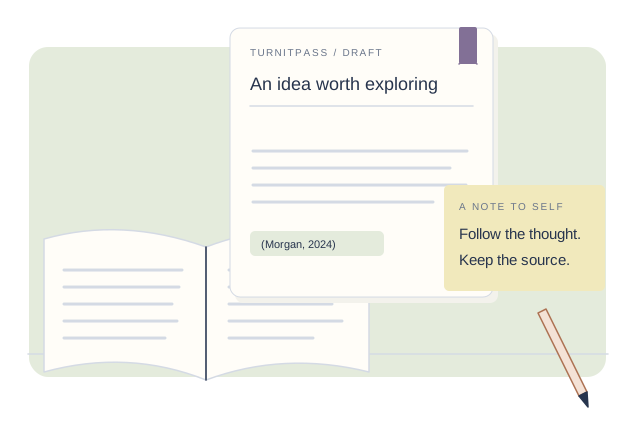
Therefore, a rigorous verification pass is a non-negotiable step in the academic writing process. Writers must check each reference against real databases (such as Google Scholar or PubMed), confirm that the cited source actually supports the claim made in the text, and format the bibliography properly. Using the Citation Generator, you can output clean, verifiable references in standard academic styles.

Furthermore, a proper citation check ensures that credit is accurately attributed to original researchers. Hallucinated sources undermine the entire foundation of academic inquiry. Taking the time to locate and verify each reference builds a stronger, more credible paper that stands up to peer and instructor review.

Using automated citation managers can streamline this process, but manual review is still essential to catch anomalies. TurnitPass integrates reference formatting directly into the workspace, allowing you to build compliance profiles in MLA, APA, or Chicago style while revising your text.

  • 1Double-check all direct quotes and paraphrase summaries against the original source documents.
  • 2Generate clean, compliant citations in APA, MLA, Chicago, IEEE, or Harvard formats using the Citation Generator.
  • 3Verify that the cited evidence directly supports the academic claim made in the surrounding paragraph.

Building a Solid Paper Trail of Outlines and Notes

If a teacher or system flags your paper, having earlier outlines, source notes, and draft versions is the best proof of authorship. A high detector score alone is not conclusive evidence of misconduct, and presenting your document's version history can resolve misunderstandings.

Having a record of your research process—including initial brainstorms, annotated bibliographies, and draft histories—provides undeniable proof of your authorship. It shows that the work evolved naturally through your own effort rather than appearing instantaneously from a generator.

Ultimately, a structured paper trail acts as your security blanket. By keeping clean records and using TurnitPass as your final editing environment, you can confidently discuss your paper with your instructor and prove your dedication to academic honesty.

In addition, document history files are highly persuasive evidence during grade appeals. Teachers appreciate seeing the revision steps, outline changes, and source notes, as it demonstrates academic effort and engagement with the assignment.

Refining the Final Draft for Submission

The final phase of the writing process should focus on style refinement and readability. Once your arguments are solid and your sources are verified, take a pass specifically dedicated to sentence variety and flow. Check that your transitions are logical and that your voice remains consistent throughout the document.

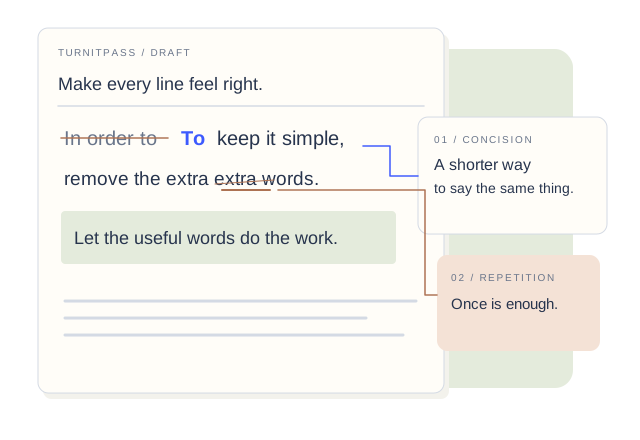
Avoid the temptation to use overly complex vocabulary or jargon simply to sound academic. The best scholarship is written in clear, precise, and accessible language. Refine your drafts to eliminate wordiness and ensure that each sentence has a clear purpose.

Using the TurnitPass editing tools, you can review your text for repetitive transitions and uniform cadences. This helps you identify sentences that might trigger flags and revise them to match human writing patterns without losing your research claims.

Finally, run a traditional proofreading pass for spelling, grammar, and punctuation. A clean, error-free document indicates academic care and respect for your reader. By following this systematic workflow, you can submit a polished paper that meets all standards of academic excellence.

TurnitinAI detectionacademic writing

使用指南

把文章落到写作流程里

博客建议要能用得上。打开对应的 TurnitPass 工具,核对输出,并把最终修改与原始草稿对照保留。

论文 AI 检测

提交前扫描学术草稿中的 AI 疑似特征。

打开

引用来源

生成 APA、MLA、Chicago、IEEE、Harvard、GB/T 等格式引用。

打开

自然化改写草稿

在论点、引用和个人表达仍清晰可见的前提下,处理 AI 痕迹明显的段落。

打开

继续阅读

全部文章
学生写作

AI Writing Tips for Students Who Still Need Their Own Voice

How to use AI for outlining and revision without submitting a draft that sounds disconnected from the student.

学生写作

Academic Integrity and AI Writing: A Practical Revision Guide

How students can use AI-assisted drafting responsibly while keeping evidence, authorship, and revision history clear.

学生写作

Best ChatGPT Prompts for Essays and How to Revise the Output

Prompt ideas can help with structure, but the final essay still needs source checks, voice, and careful rewriting.

Get started

支持英文、简体与繁体中文,一站式提供自然化改写、AI 检测、智能润色与文献引用服务。

免费开始开发者 API
TurnitPass

支持英文、简体与繁体中文,一站式提供自然化改写、AI 检测、智能润色与文献引用服务。

产品
  • 自然化改写
  • AI 检测
  • 论文检测
  • 教师版检测
  • 开发者 API
  • 文档
  • 工作台
资源
  • 套餐与价格
  • 学术博客
  • 工具对比
  • 更新日志
  • 关于我们
  • 联系我们
法律
  • 隐私政策
  • 服务条款

© 2026 TurnitPass. 保留所有权利。

All systems normal