Use ChatGPT for planning and critique, then revise the final draft around your sources, thesis, and voice.
Outline with ChatGPT, then humanize the draft
ChatGPT is useful for essay outlines, counterarguments, and gap-finding. Add your sources and thesis, then polish the language.
Use TurnitPass Citation Generator plus AI Humanizer so the draft is formatted and no longer sounds generic.
Start from your outline
AI can speed up outlining, note-taking, and a first language pass. The thesis, sources, and analysis still come from you, and that is what makes the paper worth submitting. When analyzing essay drafting with AI, build the outline first, then polish the language.
Many universities now run AI checks before grading. Start from a solid outline, add your own analysis, then use TurnitPass to polish language, format citations, or review AI-writing signals.
Use TurnitPass to polish the prose, then compare the result with your original claims before you submit.
Preserving Individual Voice and Author Identity
Instructors who read student essays regularly can easily identify prose that lacks a personal voice. AI-generated drafts often feature highly uniform sentence lengths, clinical vocabulary, and a total absence of individual style or rhetorical variation. When your essay relies on generic summaries rather than concrete arguments, it loses its academic punch. Your unique perspective, shaped by class readings, personal experiences, and unique research findings, is what makes the paper valuable.
To make your essay stand out, inject specific class discussions, personal thesis statements, and unique evidence that a generic prompt cannot generate. Replace broad, sweeping statements with narrow, focused claims. For instance, instead of claiming that technology has transformed society, describe how a specific regulatory policy impacted a particular community. TurnitPass AI Humanizer cleans up sentence flow while keeping claims, citations, and examples visible.
A strong personal voice is also characterized by syntactic flow. Human writers naturally mix short, punchy observations with longer, explanatory statements. AI models, by contrast, write with uniform rhythm. Varying your sentence length and paragraph structure manually is the most reliable way to establish a natural cadence that readers appreciate.
Active voice and varied transitions also help define author identity. Passive structures and repetitive transitions often read as AI-like. Rewriting these sentences yourself improves readability even when you later use a tool for a second pass.
An Academic Checklist for Verifying Sources
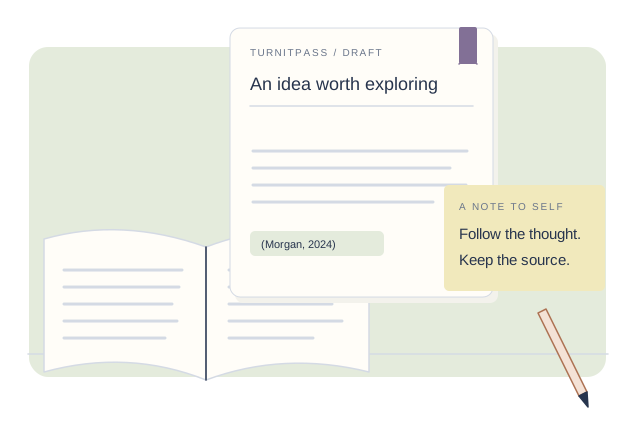
Raw generative output often invents journal titles, page numbers, and author names that look real. Check each reference against Google Scholar or PubMed, then format the bibliography.
TurnitPass Citation Generator formats DOI, URL, or manual sources in APA, MLA, Chicago, IEEE, Harvard, GB/T 7714, and more.
Use Citation Generator and Bibliography alongside AI Humanizer so references stay formatted while you polish the prose. For English drafts, add terms you want to keep unchanged.
- Double-check all direct quotes and paraphrase summaries against the original source documents.
- Format citations in APA, MLA, Chicago, IEEE, Harvard, GB/T 7714, and other supported styles with the Citation Generator.
- Verify that the cited evidence directly supports the academic claim made in the surrounding paragraph.
Keep outlines and notes
Keep your outlines and draft files, and use TurnitPass to polish the language for essay drafting with AI.
Keep brainstorms, annotated bibliographies, and successive drafts with the polished version.
TurnitPass saves rewrites, detections, and citations to history so you can reopen a draft and keep working.
Refining the Final Draft for Submission
The final phase should focus on style and readability. Once arguments are solid and sources are verified, take a pass dedicated to sentence variety and flow. Check that transitions are logical and that your voice stays consistent.
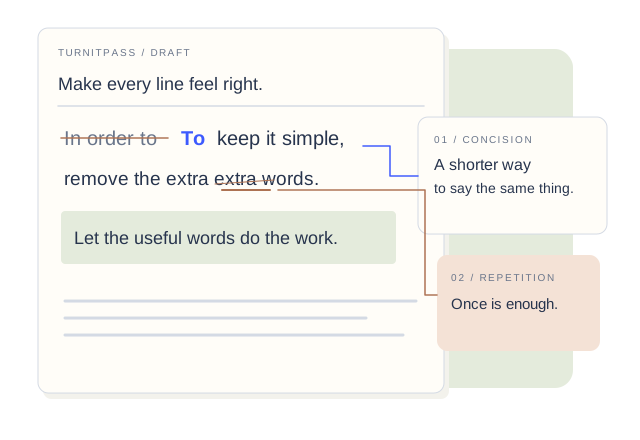
Avoid overly complex vocabulary simply to sound academic. Clear, precise language is stronger. Eliminate wordiness and give each sentence a purpose.
Choose the tool that matches the job: AI Humanizer with Natural or Deep and a target platform, AI Rewriter for academic passages, or AI Detector and AI Essay Checker to review signals before you submit.
Finish with spelling, grammar, and punctuation, then copy or download the result.