TurnitPass
PricingAPIBlog
Sign inDashboardStart free

Paraphrase & Polish

Pick a mode and intensity to rephrase a sentence, paragraph, or draft while keeping the meaning intact.

1Source passage2Polished output
Rewrite intensity52%

Paraphrase & Polish

Original draft

0/1,500 words

Polished output

Polished output

Paste, upload a document, or write directly in the editor.

Paraphrase & Polish

Sentence paraphraser, paragraph paraphraser, essay paraphraser, all in one workflow

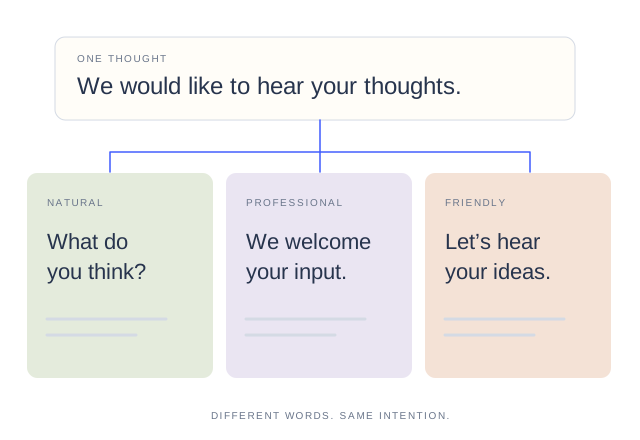
Drop in anything from one sentence to a full draft. TurnitPass changes wording, clause order, and rhythm while keeping the same idea visible, so the output is useful for source notes, second drafts, emails, blog posts, and ESL polish.

ParaphraseParaphrase
Original draft01
Meaning check02
Polished output03
What it does

Paraphrase text without flattening the original idea

A useful paraphrase is not a synonym swap. It changes structure, vocabulary, and sentence rhythm while keeping the claim, evidence, and citation context clear enough for a real writer to review.

01

Keep the claim visible

The rewrite stays close to the original point, so the new wording can be checked against the source.

02

Change more than words

Clause order, transitions, and sentence shape move together instead of replacing isolated terms.

03

Leave room for citation

When the idea comes from a source, keep the citation nearby and review the final wording manually.

How it works

Three steps from original text to paraphrased text

Step 01

Paste your text

Drop in a sentence, paragraph, essay section, source note, or draft passage. The tool reads the surrounding context before rewriting.

Step 02

Pick a paraphrasing mode

Use standard for a balanced rewrite, fluency for readability, formal for professional writing, simple for plain English, creative for more variation, or shorten for compression.

Step 03

Review the paraphrase

Copy the new wording back into your document, confirm that the meaning is still accurate, and cite the source when the idea is not yours.

Paraphrasing basics

Paraphrasing basics for academic and professional writing

The mechanics matter before any tool is involved. A paraphrase should make the writing yours without hiding where the idea came from.

What paraphrasing means

Restate the same idea in new words at roughly the same level of detail. It is different from quoting and different from summarizing.

Paraphrase vs summary

A paraphrase follows the source closely. A summary compresses a longer passage into the main point.

How to cite a paraphrase

APA, MLA, Chicago, IEEE, and other styles still require an in-text citation or note when the idea comes from a source.

A quick quality check

Read the original, close it, write from memory, then compare for accuracy and accidental copied phrasing.

Detector-aware workflow

A paraphraser alone will not beat AI detectors

Paraphrasing is a wording pass. The output can still carry language-model patterns, so detector-sensitive work should go through the humanizer after the paraphrase pass.

Open the humanizer

Recommended chain

Meaning preserved01
Clearer rhythm02
AI Detector ready03

Paraphrase -> Humanize -> Detect

Use cases

Built for the writing jobs people actually do

Case 01

Essay paraphrasing

Rework cited ideas in your own wording while keeping the citation context intact.

Case 02

Sentence cleanup

Fix a stiff sentence, change register, or make a line easier to read.

Case 03

Content refresh

Turn old paragraphs into fresher copy without drifting away from the source point.

Case 04

ESL polish

Smooth English phrasing while keeping the writer’s structure and intent recognizable.

Paraphrasing modes

Modes from light polish to aggressive changes

Pick a mode based on the writing job. Standard and fluency stay close to the draft. Creative, expand, and shorten make larger structural moves that need a closer review.

Standard

Balanced rewrite

Fluency

Smoother grammar

Formal

Professional tone

Academic

Scholarly prose

Simple

Clearer wording

Creative

More variation

How we compare

Versus generic writing tools

TurnitPass

Meaning
Preserved
Modes
8 styles
Detector pass
Pair with humanizer
Free flow
Yes

QuillBot

Meaning
Mostly
Modes
Partial
Detector pass
No
Free flow
Limited

ChatGPT

Meaning
Variable
Modes
Prompt-based
Detector pass
No
Free flow
Limited
ToolMeaningModesDetector passFree flow
TurnitPassPreserved8 stylesPair with humanizerYes
QuillBotMostlyPartialNoLimited
ChatGPTVariablePrompt-basedNoLimited
Further reading

Keep the writing workflow connected

01AI HumanizerSend flagged text to the humanizer next02CitationGenerate APA, MLA, Chicago, IEEE, and more03BibliographyBuild a clean source list from multiple references
FAQ

Frequently asked questions

Is this different from the humanizer?
Yes. Paraphrase changes wording. The humanizer is the detector-aware pass.
Can it paraphrase a full essay?
Yes, but long documents should be reviewed section by section for citations and claims.
Does a paraphrase still need a citation?
Yes. If the idea comes from a source, cite it even when the wording changes.

Get started

Humanize English, Simplified Chinese, and Traditional Chinese AI drafts, check AI-like signals, and keep writing workflows fast from one workspace.

Start freeAPI
TurnitPass

Humanize English, Simplified Chinese, and Traditional Chinese AI drafts, check AI-like signals, and keep writing workflows fast from one workspace.

Products
  • Humanizer
  • AI Detector
  • AI Essay Checker
  • AI Detector for Teachers
  • API
  • Developers
  • Dashboard
Resources
  • Pricing
  • Blog
  • Compare
  • Changelog
  • About
  • Contact
Legal
  • Privacy Policy
  • Terms of Service

© 2026 TurnitPass. All rights reserved.

All systems normal