A transparent benchmark framework for measuring whether an AI humanizer can lower AI score without damaging meaning or readability.
Why benchmark AI humanizers
Most AI Humanizer comparisons focus solely on the final AI score. That is not enough. A rewrite can score well by becoming strange, over-randomized, or less faithful to the original argument. Measuring quality requires looking at both readability and accuracy.
TurnitPass-1 is evaluated on two axes at the same time: whether the output lowers AI-like signals and whether a careful reader would still accept the text as clear, accurate, and meaning-preserving.
Writers deserve to know whether a tool will preserve their research or scramble their citations to chase a lower AI score.
Methodology: same input, same settings
A useful benchmark starts with one input paragraph and applies the same constraints to every tool: one pass, default settings, no cherry-picked regeneration, and no manual cleanup after the tool responds. This ensures a fair and repeatable evaluation.
The test input should be dense enough to matter. Academic and professional paragraphs with citations, named concepts, and compressed claims expose whether the tool preserves evidence or only rearranges wording. Simple texts fail to test structural capabilities.
- Use one published test paragraph for every run.
- Keep citations, named entities, dates, and claims visible in the source.
- Record AI scores and reader-quality notes for the exact same output.
What TurnitPass-1 measures
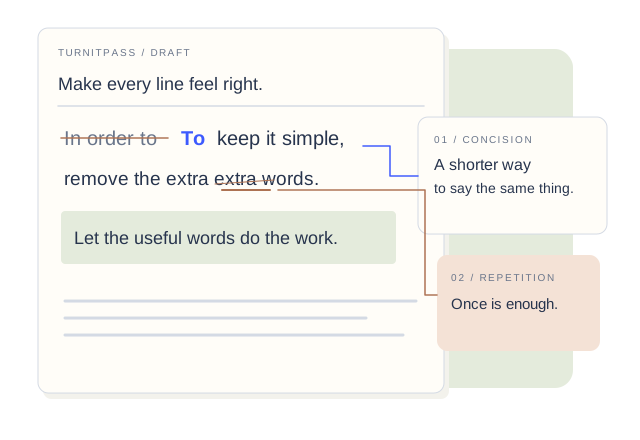
TurnitPass-1 focuses on patterns that often make AI drafts feel machine-written: uniform sentence length, repeated transitions, generic claims, overly smooth paragraph structure, and thin examples. The model refactors these markers to create a human-like flow.
The model is also checked against quality regressions. A rewrite is not accepted as strong if it drops a claim, removes source context, changes a technical term, or makes the prose awkward just to avoid predictable tokens. Accuracy must remain a hard requirement.
Quality review looks at AI-writing signal, meaning preservation, rhythm, citations, and readability. A rewrite is not treated as strong if it changes claims, drops source details, or reads unnaturally.
Lower AI score, keep the prose
AI Detector checks highlight the patterns that make a draft feel machine-written. The target is a lower AI score with prose that still reads naturally.
The stronger result is a lower AI score paired with writing that keeps the original intent intact. Clarity and readability come with that rewrite.
Writers who focus entirely on scoring metrics risk submitting essays that read like random paraphrasing. TurnitPass balances both aspects, providing an editor that satisfies detectors while producing clean, professional text.
- Low score plus readable prose is the target.
- Low score plus awkward prose is still a writing problem.
- Readable prose plus a high AI score may need another revision pass.
Quality review rubric
The quality rubric asks whether the rewrite keeps the structure of the original argument, improves flow, preserves citations, avoids grammar problems, and sounds like a plausible human revision rather than a randomized paraphrase.
This is where many AI Humanizer tools struggle. Tools that lean too hard on unusual synonyms may lower AI score but introduce phrasing a real writer would not choose. Tools that stay too close to the source may read well but leave the AI-like pattern untouched.
The TurnitPass-1 position
TurnitPass-1 is designed to sit in the top-right quadrant: strong lower AI scores and strong prose quality. It changes rhythm, transition density, and sentence structure while treating meaning preservation as a hard requirement.
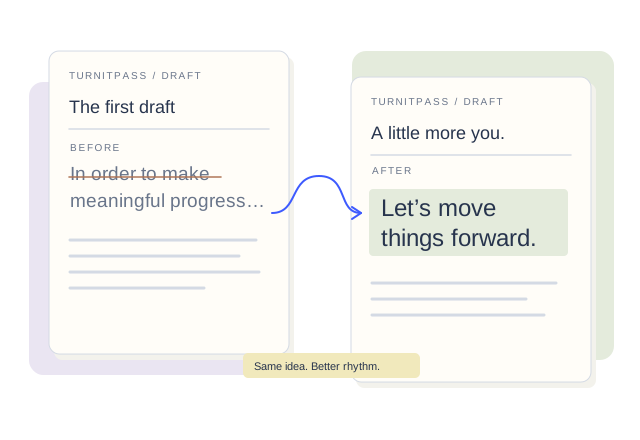
That is why AI Humanizer keeps the original draft next to the rewrite. You see the exact changes, then copy or download the version you want.
How to use the benchmark
Use one controlled input to see how a tool behaves, then try it on your own essay, email, or Chinese academic paragraph.
TurnitPass-1 lowers AI-like writing patterns, preserves evidence, and shows the diff so you can copy the version you want.